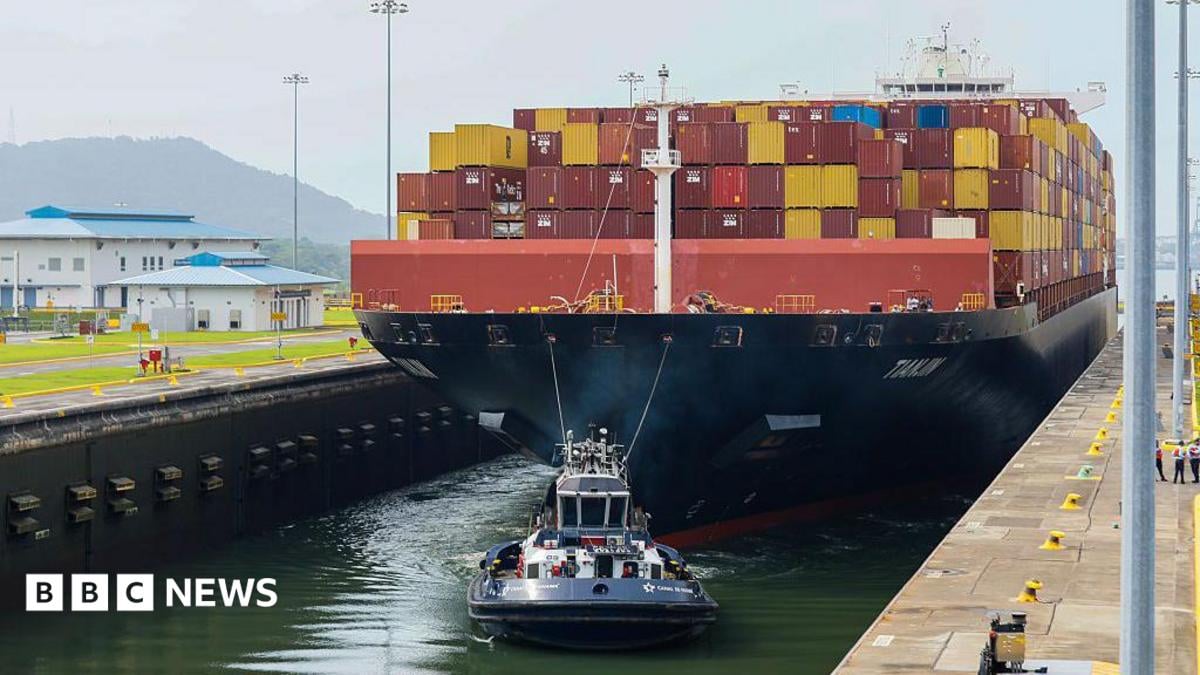
Panama Canal to cut daily ship transits as El Niño drought bites
Passages will fall from 36 to 32 vessels per day by mid-September, only the second such reduction in the canal's 110-year history.
Briefing
- The Panama Canal Authority will restrict daily vessel transits for only the second time in the waterway's 110-year history, a measure that directly raises transit costs and extends voyage times for shippers rerouting cargo between the Atlantic and Pacific.
- From 3 September, daily transits will fall from 36 to 34 vessels; a second cut to 32 vessels takes effect on 15 September.
- Low water levels in the two artificial lakes that feed the canal, caused by El Niño-driven drought across Central America, are the stated reason for the restrictions.
- The Panama Canal Authority has indicated further restrictions remain possible if drought conditions persist.
- Shipping operators and commodity traders exposed to trans-isthmus routes face rising slot scarcity and potential freight rate pressure as the Northern Hemisphere winter demand season approaches.
Analysis
- Dry bulk and LNG freight rates face upward pressure over the next 60-90 days as Panama Canal slot scarcity forces rerouting via the Cape of Good Hope, adding roughly 14-21 days to Asia-Atlantic voyages. The timing is structurally adverse: Northern Hemisphere winter energy demand builds from October, and any further restriction below 32 vessels per day tightens an already compressed slot market. Tanker and LNG operators with Atlantic-Pacific exposure absorb the cost asymmetry first.
- Agricultural commodity basis risk widens for US Gulf grain exporters: soybeans and corn destined for Asia face a forced choice between higher-cost Panama slots and longer Cape routing, compressing exporter margins as the South American harvest season approaches. If restrictions deepen below 32 vessels, US exporters lose the transit cost advantage over Brazilian competitors whose Atlantic-Pacific routing is unaffected, accelerating market share erosion that was already underway.
- CK Hutchison's ongoing $1.5bn arbitration against Panama over canal port seizures compounds operational and legal risk for the Panama Canal Authority simultaneously: transit restrictions reduce toll revenue precisely when Panama faces a potential $1.5bn arbitration liability. Panama's sovereign credit risk premium edges higher if drought conditions persist into Q1 2027, as the combination of compressed toll income and treaty-dispute exposure strains fiscal projections.
Historical Context
- 2023
A prior El Niño drought reduced Panama Canal transits to as low as 22 vessels per day by early 2024, driving a spike in Panamax and cape-size freight rates and forcing rerouting via Suez and Cape of Good Hope. That episode established the mechanical link between water level restrictions and spot freight market repricing.
- 2021
The Ever Given grounding blocked the Suez Canal for six days in March 2021, temporarily diverting traffic toward the Panama Canal and demonstrating how single-chokepoint disruptions cascade into global freight rate spikes across multiple vessel classes within days.
- 1997-1998
The 1997-98 El Niño caused severe drought in Central America, reducing Panama Canal water levels and foreshadowing the hydrological vulnerability of a lock-based canal system dependent on rainfall-fed freshwater lakes for operations.
Connected Events

CK Hutchison files $1.5bn arbitration claim against Panama over canal ports
CK Hutchison's $1.5bn arbitration claim against Panama over canal port seizures places simultaneous legal and financial pressure on the same sovereign authority now managing transit restrictions, compounding Panama's fiscal and operational risk profile.
BHP annual profit rises 30% as copper earnings overtake iron ore
BHP's record copper earnings driven by data centre and energy network demand signals that the same industrial buildout straining global freight infrastructure is also intensifying demand for the raw materials that must transit chokepoints like Panama.
Further reading

See Indexa more often on Google
Mark Indexa as a preferred source — your Top Stories will surface more Indexa coverage.