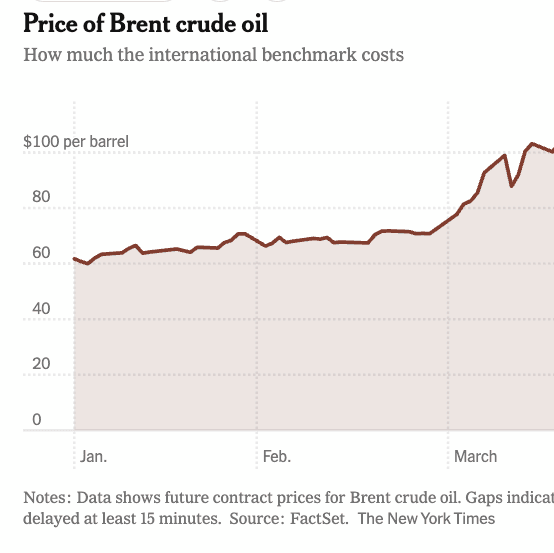
Brent crude hits $95.73 as U.S.-Iran strikes enter 12th consecutive night
Houthi threats to Saudi oil shipping through Bab el-Mandeb compound Hormuz disruption risk, lifting WTI above $88
Briefing
- Brent crude has risen to $95.73 per barrel, the highest level in more than six weeks, as the U.S. Military launched its 12th consecutive wave of strikes against Iranian military targets.
- WTI crude traded at $88.05 per barrel in early Asian session Thursday, up 1.41% on the day, with Brent gaining 1.76% on the same session.
- Two chokepoints are now simultaneously under threat: U.S.-Iran aggression is disrupting the Strait of Hormuz while Yemen's Houthis have intensified threats against vessels carrying Saudi oil through the Bab el-Mandeb strait.
- U.S. Retail gasoline has crossed $4 per gallon again, a politically sensitive threshold last breached during prior oil price spikes.
- If either waterway is materially disrupted, traders will reassess the supply cushion that has so far prevented a sharper spike despite five months of active conflict between the U.S. And Iran.
Analysis
- Brent breaking $100 in the subsequent story confirms the $95.73 level in this briefing was a waypoint, not a ceiling. With both the Strait of Hormuz and Bab el-Mandeb simultaneously threatened, the forward curve's full upward shift signals traders are pricing prolonged dual-chokepoint disruption. Saudi rerouting around the Cape of Good Hope adds 10-14 days to European delivery times, tightening spot physical supply and compressing European refining margins as feedstock costs rise faster than product cracks can recover.
- U.S. retail gasoline above $4 per gallon reintroduces a politically sensitive inflation data point that embeds directly into CPI transportation and energy components. With the IEA having issued a formal supply-risk warning and buffer-building by major importers potentially amplifying price moves, any Fed pivot narrative built on easing energy inflation is now structurally challenged. Dimon's concurrent warning that he would not buy Treasurys at current prices compounds duration risk if oil-driven CPI prints delay rate cut expectations further.
- The Albertsons guidance cut and cautious consumer deterioration now intersect directly with $4-plus gasoline: energy costs function as a consumption tax that accelerates the grocery volume pressure already visible in ACI's 15% stock decline. Conventional grocery chains and branded food manufacturers face a compounding squeeze where consumers trade down on food while discretionary budgets are further eroded by fuel costs, amplifying private-label mix shift and volume risk at names like Kraft Heinz and Campbell's.
Historical Context
- 2023-2024
Initial Houthi Red Sea attacks beginning late 2023 forced container shipping rerouting around the Cape of Good Hope, adding freight costs and extending delivery timelines. That episode demonstrated how chokepoint threats translate into persistent rather than one-session supply tightening, validating the current forward curve's contango structure.
- 2022
Russia's invasion of Ukraine drove Brent above $130 and U.S. gasoline past $5 per gallon, directly embedding energy costs into CPI and delaying Fed pivot expectations. The transmission channel then, as now, ran from physical supply disruption through retail fuel prices to consumer spending compression and central bank optionality.
- 2019-2020
U.S. drone strike killing Qasem Soleimani in January 2020 triggered a brief Hormuz closure scare and an oil spike that reversed within days once physical disruption failed to materialise. The current conflict is now in its 12th consecutive night of strikes, making a transitory reversal less likely than that precedent suggests.
Connected Events

Brent crude breaks $100 as Houthi strikes on Saudi tankers escalate Red Sea crisis
Brent broke $100 as Houthi strikes on Saudi tankers escalated, with the forward curve shifting fully higher to price prolonged dual-chokepoint disruption rather than a transitory spike.
IEA warns of supply risk as US-Iran conflict drives oil price volatility
The IEA issued a formal supply-risk warning on the U.S.-Iran conflict and noted buffer-building by major importers was accelerating, a demand-side dynamic that could amplify price moves beyond what underlying supply disruption alone justifies.
Albertsons cuts full-year outlook as cautious consumers pull back on grocery spending
Albertsons cut its full-year outlook as cautious consumers pulled back on grocery spending, establishing a pre-existing consumer stress baseline that $4-plus gasoline will compound through reduced discretionary capacity.
Further reading

See Indexa more often on Google
Mark Indexa as a preferred source — your Top Stories will surface more Indexa coverage.