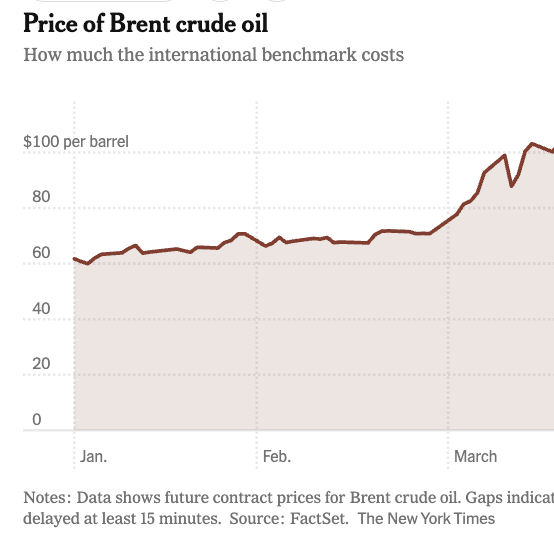
Brent crude breaks $100 as US-Iran war escalates in the Gulf
Crude has risen 40% since the conflict began; US forces destroyed five Iranian oil vessels in latest exchange
Briefing
- Brent crude crossed $100 per barrel for the first time since 24 July, with the US destruction of five Iranian crude oil vessels eliminating near-term prospects for a negotiated return to normal oil flows.
- Brent touched $100.12 in early Asian trade on Wednesday, a gain of 2.25% on the session, while WTI rose 1.80% concurrently.
- Crude prices have risen 40% in aggregate since the start of the conflict in Iran, feeding through to higher gasoline, diesel, and refined fuel costs.
- Houthi attacks on Saudi cities added a second front of supply disruption risk on top of direct US-Iran exchanges in the Gulf.
- Sustained prices above $100 will intensify inflation pressure in oil-importing economies and complicate central bank rate decisions heading into the autumn policy cycle.
Analysis
- Oil-importing Asian central banks, particularly the Bank of Japan and Reserve Bank of India, face a materially harder policy path as Brent at $100 and a 40% cumulative price gain since conflict onset feed directly into headline CPI. Both institutions enter their autumn policy cycles with reduced room to cut or hold accommodatively. India's fuel subsidy bill expands mechanically; Japan's import-cost inflation complicates the BoJ's already cautious normalisation sequencing.
- Tanker insurance and freight rates face a second structural leg higher as the US destruction of five Iranian crude vessels removes the ambiguity that allowed underwriters to price event risk as bounded. With Houthi attacks on Saudi cities opening a second disruption front, war-risk premiums now cover simultaneous Persian Gulf and Red Sea exposure. Refiners with Persian Gulf feedstock dependency, particularly in Europe and Asia, face margin compression from both higher crude cost and elevated freight.
- Chevron's $7bn Venezuela expansion, flagged two weeks ago as a supply-side counterweight to Gulf disruption, loses its near-term price-ceiling effect as Brent crosses $100. Venezuelan output doubling remains a multi-year story; the current geopolitical premium is being priced now. OPEC+ loses the political cover the Venezuela announcement provided to delay compensatory supply cuts, raising the probability of an emergency output decision before the scheduled autumn meeting.
Historical Context
- 2022
Russia's invasion of Ukraine pushed Brent above $130 in March 2022, triggering a global inflation surge that forced 40+ central banks into synchronised rate hike cycles. The mechanical pass-through from crude to headline CPI in oil-importing economies took roughly 6-8 weeks, the same lag now relevant for autumn policy meetings.
- 2019
Houthi drone strikes on Saudi Aramco's Abqaiq facility in September 2019 temporarily knocked out 5% of global oil supply and spiked Brent by nearly 15% in a single session. The current Houthi attacks on Saudi cities represent a comparable second-front disruption layered on top of direct US-Iran exchanges.
- 1990-1991
Iraq's invasion of Kuwait doubled oil prices within weeks and preceded a US recession. The Strait of Hormuz disruption risk was the primary supply shock mechanism, identical to the current Persian Gulf escalation dynamic where roughly 20% of global oil supply transits the same chokepoint.
Connected Events

WTI hits $91, Brent above $95 as Iran retaliates with strikes on US Gulf allies
Brent's move to $100 extends the pricing trajectory directly from the prior escalation where WTI hit $91 and Brent crossed $95 as Iran retaliated with strikes on US Gulf allies, confirming a sustained $5+ per escalation step pattern rather than a one-time spike.

Dutch central bank shifts 86 tonnes of gold from New York and Canada to London citing geopolitical risk
De Nederlandsche Bank's gold repatriation from New York to London, framed explicitly around geopolitical risk, now looks prescient as US-Iran hostilities reach a new intensity level. European sovereign institutions holding US-custodied hard assets face renewed pressure to accelerate geographic diversification reviews.

Chevron pledges $7bn to more than double Venezuela oil output
Chevron's $7bn Venezuela commitment, announced a week ago as a supply counterweight to Gulf disruption, is now structurally insufficient to cap Brent near-term given the pace of escalation, undermining the price-ceiling thesis embedded in that investment narrative.
Further reading

See Indexa more often on Google
Mark Indexa as a preferred source — your Top Stories will surface more Indexa coverage.