Briefing
- TSMC reported a 77% year-on-year jump in second-quarter net profit, far surpassing analyst expectations and marking the company's fifth straight quarter of record earnings.
- The result confirmed expectations flagged ahead of the formal release, with AI-driven demand for high-end chips the primary growth engine.
- June revenue had already signalled strength, surging 68% year-on-year to $13.2 billion, breaking a four-year seasonal deceleration pattern.
- Full Q2 revenue rose 36% year-on-year, reflecting continued translation of AI infrastructure spending into leading-edge foundry volumes.
- TSMC raised its sales and capital spending outlook alongside the results, citing AI as a structural megatrend, and announced an additional $100 billion investment in Arizona as part of a broader US$265 billion US buildout.
- Reports indicate TSMC cannot keep up with demand for its CoWoS advanced packaging capacity, with orders spilling over to Intel and rival Taiwanese fabs.
Analysis
- TSMC's 68% June revenue surge and record Q2 beat shifts investor attention to July 16 guidance, where any upward revision to Q3 capacity utilization or advanced packaging availability directly pressures Nvidia, AMD, and Broadcom lead times. The demand signal is unambiguous at the foundry level; the risk is now whether TSMC's CoWoS and SoIC packaging capacity can keep pace, constraining AI accelerator shipment schedules even if wafer demand remains robust.
- Samsung's Q2 share decline on a near-1,900% profit beat already established that AI chip upside is fully priced in Korean memory names, but TSMC's 36% revenue growth print now creates an asymmetric divergence: foundry names with direct AI infrastructure exposure re-rate on volume confirmation, while memory names face earnings-season sell-the-news pressure. Micron, as the most liquid US proxy for HBM demand, faces a split read: TSMC's result validates end demand, but the Samsung precedent caps the multiple expansion available on Micron's own print.
- TSMC's result validates sustained hyperscaler AI capex, directly supporting Meta's C$13bn Alberta data centre commitment and reinforcing the spending trajectory that Meta, Microsoft, and Google have guided. Fed minutes showing a 'deeply divided' committee with a hawkish faction raises the discount rate applied to long-duration AI infrastructure spending; TSMC's volume confirmation is the demand-side counterweight that has so far prevented that rate risk from repricing AI capex multiples lower.
Historical Context
- Jan 2025
DeepSeek's R1 release triggered a single-session selloff in AI chip names including Nvidia, raising questions about whether efficient open-weight models would reduce foundry demand. TSMC's subsequent earnings prints showed no volume deceleration, establishing that model efficiency gains did not translate into reduced wafer consumption at scale.
- 2022-2023
TSMC's prior AI demand cycle saw advanced packaging capacity, specifically CoWoS, become the binding constraint on Nvidia H100 shipments, causing multi-quarter lead time extensions even as wafer capacity was available. The same packaging bottleneck dynamic is the primary risk investors will probe on the July 16 call.
- 2021
During the semiconductor supercycle, TSMC's monthly revenue disclosures consistently led broader chip sector re-ratings, with each record print pulling forward capex commitments from customers and compressing equipment lead times. The July 16 guidance will be watched for the same capital allocation signal from Apple, Nvidia, and AMD.
Connected Events
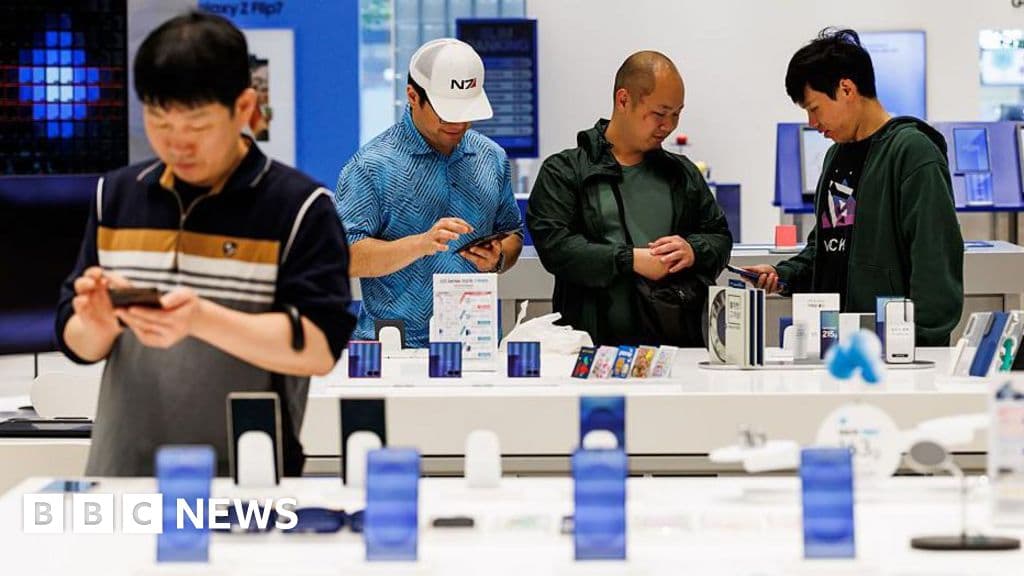
Samsung Q2 operating profit surges ~1,900% on AI memory chip demand
Samsung's Q2 operating profit surged roughly 1,900% on AI memory demand, yet shares fell as investors concluded the upcycle was fully priced. TSMC's 68% June revenue surge tests whether the same sell-the-news dynamic applies to foundry names or whether volume-based revenue beats carry different multiple implications than margin-driven profit beats in memory.

SK Hynix raises $26.5bn in blockbuster US share offering debut
SK Hynix's $26.5bn US listing debut was followed by a 10% Seoul selloff, reinforcing that AI chip demand is priced into Korean equities. TSMC's record Q2 result now provides the demand-side confirmation that institutional investors in the SK Hynix US listing needed to validate their HBM thesis, but the Seoul discount dynamic complicates how that confirmation is priced across jurisdictions.

Fed Officials Split on Rate Path at Warsh's First Meeting as Chair
Fed officials were described as 'deeply divided' at Warsh's first meeting, with a faction explicitly advocating a rate hike. TSMC's AI demand confirmation reinforces the capex spending trajectory that is feeding into services inflation, giving the hawkish Fed faction additional ammunition while simultaneously providing earnings support for the AI infrastructure names most sensitive to rate repricing.
Further reading

See Indexa more often on Google
Mark Indexa as a preferred source — your Top Stories will surface more Indexa coverage.